How to Choose a Restoration Company Bakersfield
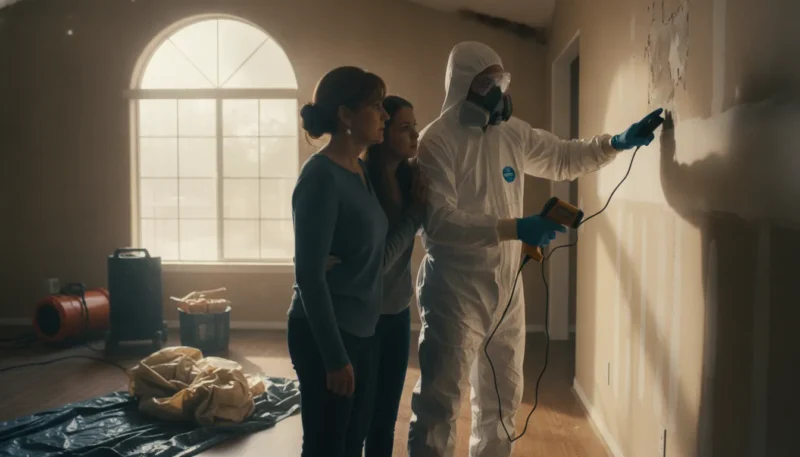
When water, fire, mold, or sewage damage disrupts your Bakersfield property, the first company to answer is not always the right company to hire. A reliable restoration team should explain its training, arrival expectations, local coverage, work process, reviews, insurance documentation, and agreement terms in plain language.
Call (661) 220-7584 for 24/7 emergency restoration help.
Knowing how to choose a restoration company bakersfield homeowners can trust starts with five checks: relevant credentials, realistic emergency response, local accountability, consistent customer feedback, and a written scope of work. Use those checks before comparing price so you can choose a team prepared for the specific damage affecting your home or business.
This guide is designed for homeowners, landlords, property managers, and business owners in Bakersfield and surrounding Kern County communities. For a broader look at local coverage, bilingual support, and the trust signals behind 911 Restoration of Bakersfield, visit the local restoration company trust guide.
What Certifications Should a Restoration Company Have?
Look for relevant IICRC training, experience with your type of loss, proof of insurance, and a process for documenting the work. Credentials do not guarantee a perfect outcome, but they provide a practical way to screen for training, established procedures, and professional accountability before work begins.
Start with IICRC training and applicable standards
The Institute of Inspection Cleaning and Restoration Certification, or IICRC, is a recognized industry organization for cleaning, inspection, and restoration training. Ask whether the company and the technicians assigned to your property hold credentials that match the job. Water damage, fire and smoke damage, mold remediation, and sewage cleanup involve different materials, hazards, and procedures.
For a water loss, ask how the company applies the IICRC S500 standard. The standard describes professional water damage restoration practices that include assessment, drying, and documentation. A technician should explain how moisture will be measured, which materials may need removal, and how the team will confirm that drying goals have been reached. Read the IICRC S500 information for additional context.
Verify credentials instead of accepting a badge
Ask for the names and roles of the technicians who will perform the work. You can use the IICRC Global Locator to check listed credentials, then request proof of current insurance. Ask about experience with the actual event, whether that means a burst pipe, sewage backup, storm intrusion, fire, or mold after prolonged moisture.
If mold is involved, be especially careful with certification claims. The EPA advises homeowners to ask about qualifications, training, experience, and references. The EPA also notes that it does not maintain a certification program or official list of mold remediation firms. Review the company’s inspection, containment, cleaning, and moisture-control plan rather than treating a label as the complete answer.
911 Restoration of Bakersfield identifies its leadership as IICRC Master-certified. Its water damage and mold repair service information can help you understand the type of service scope to discuss with any restoration provider.
Why Does Response Time Matter After Property Damage?
Fast response matters because active water, smoke residue, and contaminated materials can create additional damage while a property waits. A dependable restoration company should answer around the clock, provide realistic arrival expectations for your address, and give safe instructions until a trained technician can assess the site.
Ask what emergency availability really means
Emergency availability should be more than a voicemail after business hours. Ask whether the company can dispatch trained technicians at night, on weekends, and during holidays. The first response may include locating the source, assessing visible hazards, extracting standing water, and setting up drying equipment. It should also include clear instructions about what to avoid until the site is evaluated.
The EPA notes that mold can grow on wood, drywall, carpet, and furniture when they remain wet for more than 24 hours. That does not mean mold will develop in every incident, but it shows why waiting to address moisture is a poor strategy. The EPA flood cleanup and indoor air guidance also emphasizes safety when a building or water may be contaminated.
Compare arrival promises with communication
911 Restoration of Bakersfield offers 24/7/365 emergency availability and a customer-supported 45-minute on-site arrival commitment. Arrival can depend on location, road conditions, emergency volume, and site access, so treat any promise as a response expectation rather than an impossible guarantee for every circumstance.
A good company communicates honestly if conditions change. Ask when a technician can arrive, what the first visit includes, and who will update you afterward. Fast action does not replace careful work. It creates the opportunity for a safer inspection, earlier mitigation, and better documentation.
- Stop the source only if you can do so safely. Never enter standing water near electrical equipment.
- Ask whether the assessment will identify moisture beyond what is visible.
- Confirm how the company will protect people, pets, and unaffected areas.
- Ask when moisture readings and progress updates will be provided.
Does Local Coverage Matter More Than a Big Brand Name?
Local coverage matters because the company must reach your property, understand the area, and remain accountable after the first emergency visit. A national network can provide systems and resources, while a locally operated team can add community knowledge, direct communication, and practical follow-through. Evaluate both rather than choosing by name recognition alone.
Evaluate local accountability and language access
911 Restoration of Bakersfield is a family-owned operation serving Kern County and surrounding regions. A local team can be especially helpful when a loss affects a rental property, a multi-unit building, or a business with customers and employees to consider. Ask who will manage your project, how updates will be documented, and how the company handles work after the initial cleanup.
Clear communication is part of restoration quality. The team provides support in English and Spanish. This helps homeowners and decision-makers understand safety instructions, the scope of work, insurance documentation, and next steps in the language most comfortable for them. That access can make it easier to ask questions before approving work.
Look for complete capability, not just a nearby address
Distance alone does not establish that a company is prepared. Ask whether the team can manage the path from emergency mitigation through cleaning, repairs, and reconstruction when needed. Useful technical indicators may include moisture meters and thermal imaging, extraction equipment, air movers, dehumidifiers, cleaning, and sanitizing as appropriate for the loss.
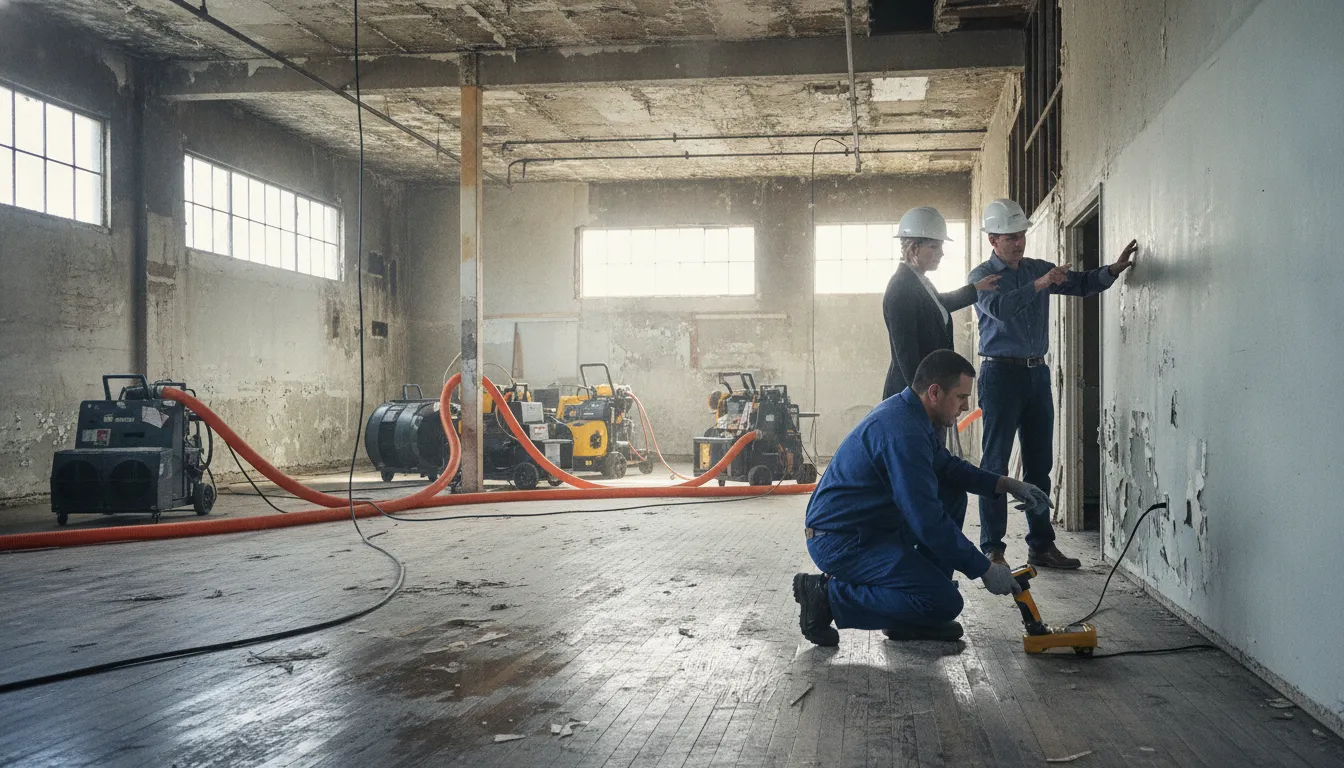
For fire losses, cleanup can involve smoke residue, odor, structural cleaning, and documentation beyond visibly burned materials. Review the fire and smoke damage service information when comparing what different providers include. For a business or property manager, review the commercial water damage restoration guide to identify questions about downtime, coordination, and documentation.
| Category. | What to verify. |
|---|---|
| Coverage. | Service area, property types, after-hours dispatch, and realistic arrival timing. |
| Communication. | Primary contact, preferred language, update schedule, and escalation process. |
| Technical scope. | Assessment, extraction or cleanup, drying, sanitation, repairs, and documentation. |
| Accountability | Local ownership or management, written terms, and a clear follow-up process. |
How Can You Verify a Restoration Company’s Reviews and Track Record?
Use reviews as a pattern-checking tool, then confirm references, qualifications, communication, and documentation directly. Look for repeated evidence about punctuality, respectful technicians, clear updates, thorough cleanup, and follow-through. One star rating or testimonial cannot show how a company handles the specific loss affecting your property.
Read for consistent details across platforms
Read recent reviews on more than one platform. Note whether customers describe timely arrivals, careful explanations, organized communication, clean work areas, and resolution of unexpected issues. A single complaint may not represent the company, but repeated concerns about missed appointments or unclear billing deserve a direct question before signing.
Request relevant references and test communication
Ask for references from customers who had a similar problem, such as a burst pipe, sewage backup, fire, mold concern, or commercial water loss. Ask what happened, how the company handled unexpected damage, whether the scope changed, and how well the team communicated. The EPA recommends asking about qualifications, training, and experience, then checking references for professionals under consideration. Its guidance on evaluating mold remediation professionals offers useful questions.
Pay attention during the first call. A trustworthy representative should answer direct questions, explain the next step, and give you a reliable way to reach the project lead. If you feel pressured to sign before the scope is explained, pause and request the information in writing.
Check documentation, not just reputation
Before major work starts, request photos or moisture readings when relevant, a written scope, an itemized estimate, progress updates, and a record of completed work. The documentation should make clear what was inspected, what was removed or dried, what remains, and what follow-up is recommended. This is useful for homeowners, landlords, property managers, insurers, and business owners.
What Questions Should You Ask Before Signing an Agreement?
Before signing, ask the restoration company to explain the scope, timeline, documentation, insurance responsibilities, payment terms, change approvals, and warranty in plain language. Coverage and cost depend on your policy, the damage assessment, and the work required. Do not rely on a verbal promise or a generic estimate for a complicated loss.
What exactly is included in the scope?
Ask whether the scope includes inspection, emergency mitigation, water extraction, drying, cleaning, sanitizing, odor control, demolition, repairs, and final documentation. Clarify whether the agreement covers emergency mitigation only or also reconstruction. If walls, flooring, cabinets, or other materials may need removal, ask what condition triggers removal and who authorizes it.
How will the company document damage and progress?
Ask whether technicians will take photos, record moisture readings, identify affected rooms and materials, and provide copies of relevant records. Good documentation helps you understand the work and can support an insurance claim. It also gives landlords and property managers a practical record for owners, tenants, and maintenance files.
What is the timeline, and who handles changes?
Request an expected schedule for the initial assessment, mitigation, drying checks, removal, and reconstruction. Ask how often updates will be sent and who your primary contact will be. Hidden damage, weather, material availability, and inspection findings can change the plan. The agreement should explain who approves scope changes and how additional work is documented.
How will insurance billing and payment responsibility work?
Ask whether the company can communicate with your insurance provider and help organize claim documentation. Confirm what you remain responsible for, including deductibles, excluded work, non-covered damage, or balances the policy does not pay. Insurance assistance is not a guarantee of coverage. Have the company and your insurer clarify policy-specific questions before authorizing major work.
What warranty or follow-up terms are provided?
Ask what warranty applies to mitigation, cleaning, repairs, or reconstruction, how long it lasts, and what it excludes. Confirm how to report an issue after the crew leaves and whether a final walkthrough or completion report is included. Clear answers now can prevent misunderstandings once work is underway.
How to Choose a Restoration Company Bakersfield Homeowners Can Trust
Choose the provider that combines verified qualifications, realistic emergency response, local accountability, relevant technical capability, consistent reviews, and a clear written agreement. The lowest estimate is not automatically the best value if it omits drying, documentation, sanitation, repairs, or follow-up that your property needs.
Use this decision order
- Protect people first. Follow safety instructions and avoid contaminated water, unstable structures, and electrical hazards.
- Confirm the match. Check that the provider handles your damage type, property type, and Bakersfield or Kern County location.
- Verify the team. Ask about relevant IICRC training, insurance, experience, equipment, and who will manage the project.
- Compare the plan. Review the assessment method, scope, timeline, documentation, payment responsibilities, and warranty.
- Choose clear communication. Select the company that answers questions directly and explains uncertainty without pressure.
For water damage, review the company’s water damage restoration services before calling. For fire, smoke, mold, sewage, or commercial loss, adapt the same questions to the specific hazards and property needs.
A reliable restoration company should make the property safer, explain the work, document the process, and remain available through the next stage of recovery. Those standards give homeowners and property managers a stronger basis for choosing than a name, badge, or low initial price alone.
Ask 911 Restoration of Bakersfield about your restoration needs
Frequently Asked Questions
What certifications should a restoration company have?
Look for relevant IICRC training and ask which technicians will handle the work. For water damage, ask how the company applies the IICRC S500 standard. Request proof of insurance and experience with your type of loss. For mold, review qualifications, training, references, containment, cleaning, and moisture-control procedures rather than relying on a certification claim alone.
Why is a 24/7 emergency response time important?
Damage can worsen while you wait, especially when water remains active or materials stay wet. The EPA notes that mold can grow on wet wood, drywall, carpet, and furniture after more than 24 hours. A company that answers around the clock can begin assessment and mitigation sooner. Ask what arrival time is realistic for your location.
What equipment should a restoration company use?
A complete assessment may include moisture meters and thermal imaging to find hidden moisture. Depending on the loss, technicians may also use extraction equipment, air movers, dehumidifiers, and cleaning or sanitizing products. Ask how readings will be documented and how the team will confirm that affected materials are dry or otherwise properly addressed.
How can I verify if a restoration company is reliable?
Read recent reviews for patterns in communication, documentation, punctuality, and follow-through. Ask for references from similar water, fire, mold, sewage, or commercial projects. Confirm relevant qualifications, proof of insurance, a written scope, and the identity of your project contact. Direct answers before signing are an important reliability signal.
What should I review before signing an agreement?
Make sure the agreement explains the work scope, documentation, expected timeline, insurance billing process, payment responsibility, change approvals, and warranty terms. Ask who authorizes additional work if hidden damage is found. Do not assume insurance covers every service. Request a policy-specific explanation from your insurer before authorizing major work.
Contact Us for Your Next Restoration Step
When property damage disrupts your home or business, a clear plan can make recovery easier to manage. Contact 911 Restoration of Bakersfield for 24/7 emergency restoration help, straightforward guidance, and a practical next step.
Contact 911 Restoration of Bakersfield or call (661) 220-7584
