
How Should a Hotel Respond to a Sewage Backup?
A sewage backup in a hotel is stressful because it can affect guest safety, room availability, and daily operations at once. The right response to a sewage backup starts with keeping people away from the affected area, stopping access to the source when safe, and bringing in qualified help to assess and clean it. If you are comparing hotel sewage cleanup services, use this guide to organize the first decisions and ask clear questions of your restoration provider.
What should hotel staff do first?
Act promptly, but do not rush staff or guests into the affected space. Treat sewage-contaminated water as unsafe to touch. The backup may contain material that is not visible, and staff should not attempt to determine its safety by appearance or smell. Keep guests, employees, and vendors out until the area has been assessed and cleared for the appropriate work.
- Protect people. Move guests and staff away from the affected rooms, bathrooms, corridors, or service areas. Use barriers, signs, or staff direction to prevent entry. If anyone has had contact with the water, follow your organization’s health and safety procedures and seek appropriate medical guidance as needed.
- Notify the incident lead. Contact the manager on duty and facilities or engineering lead. Assign one person to coordinate decisions, records, guest communication, and vendor access so staff do not give conflicting instructions.
- Stop use of affected fixtures. Ask occupants and staff not to use toilets, sinks, showers, or drains in the affected area until the source is understood. Do not flush or run water to test a suspected blockage.
- Isolate the area if safe. Close doors or block access without stepping into contaminated water. If you can reach a shutoff without exposure or creating another hazard, follow the property’s procedures. Do not handle electrical equipment in a wet area.
- Call for help. Contact a qualified restoration provider and, if the problem may involve a public sewer, the local utility or public works department. The right municipal contact depends on the property’s location and the source of the backup.
For an active incident, prioritize safety and qualified assessment over trying to preserve room availability. Do not use housekeeping staff or maintenance workers as a substitute for a trained cleanup team. Internal response plans should specify who can authorize a room closure, contact the insurer, and arrange temporary guest accommodations.
Keep the response organized with a brief handoff between shifts. The manager on duty can record what has happened, which areas are closed, who has been contacted, and what decision is still pending. Make sure the next shift knows not to remove barriers, restart affected fixtures, or move materials from the restricted area. A short written update is more dependable than relying on a verbal message passed between busy teams.
Use the hotel’s established emergency and workplace safety procedures. If the backup is near electrical equipment, a kitchen, an elevator, or another location where access could create additional hazards, leave the area and involve the appropriate qualified personnel. Do not ask employees to troubleshoot equipment in contaminated or wet conditions. The incident lead should assign someone to monitor the perimeter and route questions to the designated manager instead of allowing individual staff to enter and inspect.
Separate immediate response from root-cause investigation. Staff can report where water appeared and when, but should avoid declaring that the cause is a city sewer, a blocked building drain, or a particular fixture until it is assessed. That distinction affects who may need to be called and what repairs are required. Record observations in neutral terms and pass them to the plumber, utility, or restoration provider.
How should you limit disruption to guests?
First identify the affected footprint: the room or rooms where water appeared, any adjacent spaces, and the route the water may have traveled. Sewage can move beyond the place where it first becomes visible. Affected spaces may include bathrooms, guest rooms, corridors, storage areas, laundry or food-service areas, and lower floors, depending on the building layout and incident. Do not assume a nearby room is unaffected simply because its floor looks dry.
Keep guests away from the affected space and provide a simple, factual explanation without speculating about the cause or promising a reopening time. If a guest room is involved, follow hotel policy for relocating the guest and handling belongings. Protect privacy when moving people or communicating with other guests. Staff should not discuss another guest’s room, health, or personal items in public areas.
Consider the operational connections as well as the visible wet area. If the affected space is near a shared corridor, elevator, laundry area, restaurant, or mechanical room, have the facilities lead assess whether access or operations need to change. Avoid routing guests or staff through a contaminated area. If a common service is interrupted, tell the relevant teams what is unavailable and where an approved alternate route or facility can be found.
For a property with multiple buildings or floors, create a simple map or list of affected and restricted areas. Give the front desk, housekeeping, engineering, security, and management the same current information. Update the restriction only after the person responsible for the cleanup and the hotel’s designated manager agree that access is appropriate. For broader building impacts, the hotel may also need a coordinated commercial damage restoration plan.
Who should you contact, and when?
Do not assume every backup is caused by the same problem. It may involve a plumbing blockage within the property, a building drain, or a public sewer issue. A restoration provider can assess damage and perform cleanup, but the hotel may also need a plumber, property owner or manager, insurer, or local utility. Keep the roles clear: identify who is investigating the source, who is managing contaminated-material cleanup, and who has authority to approve repairs or reopen space.
If the source appears to be connected to a municipal sewer, report it to the appropriate local utility or public works department and ask what information it needs. Local processes differ. For example, the City of Minneapolis sewer-issue page directs residents to contact 311 about a sewer backup and notes that property owners can submit a damage claim. The City of Pleasanton sewer service information describes procedures that include responses to backups into buildings. These are examples of city-specific guidance, not Bakersfield instructions; contact the local authority for the property’s jurisdiction.
Notify the insurer or the person responsible for the hotel’s insurance as soon as practical, and ask what documentation or approval is needed before work begins. Coverage and claim requirements depend on the policy and circumstances, so avoid assuming that a particular cost or loss will be covered. The hotel can also review its process for insurance claim assistance and keep the insurer’s directions with the incident file.
What information should the hotel document?
Good records help the hotel make decisions and explain what happened to its insurer, owner, and service providers. Choose one person to maintain a time-stamped incident log. Record facts rather than guesses, and distinguish what staff observed from what a contractor later determined.
- Timeline: when the backup was first reported, when staff restricted access, whom the hotel notified, and when each responder arrived.
- Location and scope: room numbers or facility areas affected, the apparent point of entry, visible spread, and any adjoining spaces inspected. Keep sensitive guest information secure.
- Photographs: if it is safe to take them from outside the restricted area, photograph visible conditions before cleanup. Do not enter the area to get a better image or move contaminated items for a picture.
- Operational actions: rooms taken out of service, guest relocations, interrupted services, access restrictions, and who approved each decision.
- Communications: names and contact details of the utility, restoration provider, plumber, insurer, and property decision-makers, plus the time and substance of instructions received.
- Work records: written scope, inspection notes, work dates, materials removed, drying or cleaning records provided, and any recommendations for follow-up.
Store the records in the hotel’s approved incident system and limit access to staff who need them. Do not include unnecessary guest details in general maintenance logs. If personal belongings are involved, document the process for handling them without exposing employees or guests to contaminated materials.
What happens during professional sewage cleanup?
The provider should begin by understanding the incident, protecting the work area, and identifying what needs attention. Ask for a clear explanation of the proposed work before it begins. The exact approach depends on the material, affected surfaces, building layout, and extent of damage; no single checklist can replace an on-site assessment.
- Assessment and work planning. The provider reviews the reported source and affected areas, notes visible damage, and explains the proposed boundaries and sequence. Ask what additional rooms or building systems need inspection and how changes to the scope will be communicated.
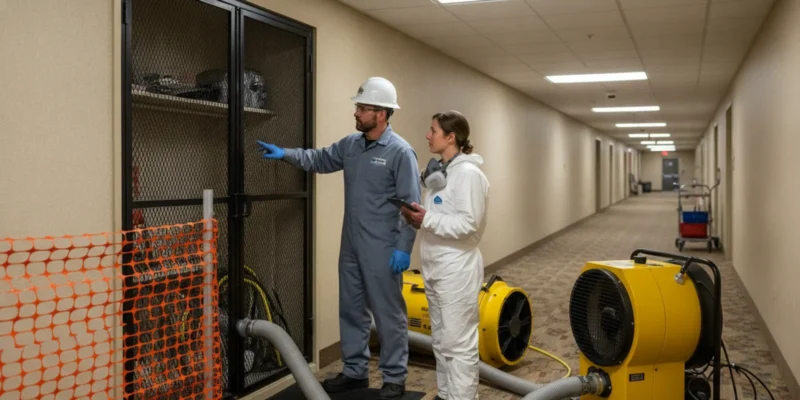
- Access control and containment. The work zone is separated from occupied areas as appropriate. The provider should explain how workers will enter and leave, how equipment and removed materials will be handled, and what routes hotel staff must keep clear.
- Removal of contaminated water and materials. Cleanup may include extraction and removal of materials that cannot be appropriately cleaned. Ask which items are expected to be removed, how they will be handled, and how the decision will be recorded. Do not promise guests that a particular item can be saved before it is assessed.
- Cleaning, sanitizing, and drying. The work plan should address affected surfaces and moisture. Ask what cleaning steps are planned, where drying equipment will be placed, and what the team will monitor. Hotel staff should not move equipment or enter the zone without approval.
- Review and next steps. Before the space returns to use, ask what work is complete, what remains, and whether further repair or monitoring is recommended. Keep the completion notes with the incident file and coordinate the reopening decision with the hotel’s responsible manager.
For more information about the scope of sewage backup cleanup, review the service page and ask the provider how its plan applies to your building. A hotel may need restoration work coordinated with plumbing repairs or building repairs. Do not treat a cleared drain alone as proof that all affected rooms are ready for guests.
How can you compare hotel sewage cleanup services?
When comparing providers, focus on whether they can explain the work, communicate with a commercial property team, and keep the incident’s documentation organized. Ask who will be the point of contact, how the provider will coordinate access with hotel staff, and how it will identify and communicate changes in scope. Request written answers when possible so decision-makers can compare the same information.
| What to compare | Questions to ask | What a useful answer should clarify |
|---|---|---|
| Assessment | How will you determine which rooms and materials are affected? | Inspection approach, affected-area boundaries, and how additional findings are reported. |
| Safety and access | How will you restrict the work zone and coordinate with hotel operations? | Entry restrictions, staff responsibilities, equipment placement, and guest-flow considerations. |
| Cleanup scope | What work do you propose, and what could change the plan? | Planned removal, cleaning, drying, and the process for approving added work. |
| Schedule and communication | Who will update our manager, and how often? | A named point of contact, expected update cadence, and how delays or new findings are communicated. |
| Records and closeout | What documentation will we receive when work is complete? | Written scope, work notes, and any follow-up recommendations for the hotel’s records. |
| Insurance coordination | Can you provide documents our insurer may request? | Which records are available and who will coordinate; coverage decisions remain with the insurer. |
Price alone does not tell you whether a proposed scope addresses the full affected area. Compare providers on scope, exclusions, communications, and documentation. Do not rely on an unsupported promise about coverage, a guaranteed reopening time, or a result that cannot be verified. A written plan gives hotel decision-makers a practical basis for review and approval.
For a local provider, you can check the company’s IICRC certification information and service-area information, then ask how the team would coordinate with your property’s manager and insurer. If you are in the Bakersfield area and need to discuss an incident, use the contact page to request help.
Discuss cleanup for your hotel
When can the affected area reopen?
There is no responsible universal reopening time for every sewage backup. The decision depends on the incident, the areas affected, the work performed, any remaining repairs, and the hotel’s own safety and operating procedures. Keep the affected area restricted while cleanup is underway. Ask the restoration provider to explain the status of the work and any conditions that remain before the hotel considers returning the space to service.
The hotel’s designated manager should coordinate with the restoration provider and any other responsible parties, such as the property owner, insurer, or local authority. Confirm that planned cleanup is complete, that any follow-up work is assigned, and that access restrictions can be lifted. If work is unfinished or the source has not been addressed, do not treat a visual check by hotel staff as a substitute for professional direction.
What should the hotel do after the immediate response?
Once the immediate incident is under control, review how it was reported and managed. Record any gaps in staff notification, access control, vendor contacts, and guest communication. Update the property’s response plan with the names or roles responsible for decisions, the current utility contact process, and the location of shutoff information. Train the relevant teams on how to report an incident and keep people away from a potentially contaminated area.
Also check whether the incident revealed maintenance or drainage issues that require separate investigation. Assign follow-up work, set a responsible owner, and retain the records alongside the cleanup documentation. A concise, updated response plan helps the next manager act consistently if another backup occurs.
A hotel response works best when it protects people first, limits access, documents what staff observe, and coordinates the right professionals without guessing at the cause or reopening conditions. Keep the affected space closed until the responsible parties confirm the cleanup and any needed follow-up are complete.
